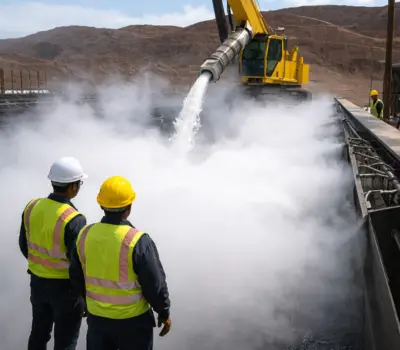
• Dry Fog Dust Suppression System in Qatar

    SFLO supplies and integrates advanced dry fog dust suppression systems in Qatar for dust-intensive industries like mining, cement, construction, and material handling. Our solutions use ultra-fine water droplets to control airborne dust at the source — without wetting surfaces.

What Is Dry Fog Dust Suppression?

Dry fog systems use specialized nozzles to atomize water into 1–10 micron droplets, which collide with and trap dust particles. The dust becomes heavier and falls to the ground — without wetting equipment or surroundings. This makes dry fog ideal for dust control in sensitive areas.

Key Components & Technology

ComponentFunction
Air Atomizing NozzlesGenerate ultra-fine water droplets (1–10 microns) for effective dust binding
Ultrasonic NozzlesEnable high-efficiency fogging at low water pressure
Water Control UnitsRegulate flow and ensure proper filtration before atomization
Compressed Air SystemsSupply air pressure required for nozzle atomization
Control PanelsManual or automated operation for zone-wise fog control

Installation Services

01
🔍

On-site Assessment & Fog Zone Planning

Our engineers visit your site to evaluate dust generation points and environmental factors. Based on this, we create a fog zone layout that ensures optimal coverage for maximum dust control.

02
🧩

Nozzle Placement & Pipe Routing

We strategically place air atomizing or ultrasonic nozzles to align with dust discharge areas. Piping is routed efficiently to avoid obstruction and ensure uniform mist distribution.

03
🔗

Integration with Water & Air Supply Lines

We connect the system to your existing water and compressed air supply, using high-grade fittings and regulators to maintain consistent pressure and flow rates.

04
🖥️

Mounting of Control Panels and Valves

Manual or automatic control panels are installed in accessible locations, with all valves and control units properly labeled and secured for easy operation and maintenance.

05
🧪

System Testing and Performance Calibration

Once installed, the system undergoes a full pressure and spray pattern test. We fine-tune nozzle angles, air-water mix, and timer settings to achieve optimal droplet size and dust coverage.

06
👷

Operator Training for Safe Usage

We train your personnel on system operation, maintenance protocols, troubleshooting basics, and safety precautions to ensure effective long-term performance.

Dry Fog Dust Suppression System Applications in Qatar

Dry fog dust suppression systems are widely adopted across Qatar’s industrial sectors where airborne dust needs to be controlled without wetting surfaces. Key applications include:

Crusher & Conveyor Transfer Points

Minimizes fugitive dust during material movement and crushing operations in aggregate and mining plants.

 Hoppers, Silos & Chutes

Suppresses dust generated during material loading, unloading, and flow transitions.

Demolition & Bulk Material Handling

Controls particulate matter during demolition activities and open bulk transfers like sand, limestone, or ore.

 Mining & Quarrying

Ideal for open-pit mines, haul roads, and extraction zones where dust suppression must not interfere with equipment.

Chemical & Fertilizer Plants

Maintains air quality in environments with fine powder or volatile dust particles that pose health and safety risks.

Coal, Cement & Mineral Loading Zones

Prevents environmental dust escape at ship loaders, conveyor ends, and truck loading/unloading points.

Dry Fog Dust Suppression System Applications in Qatar

Advantages of Dry Fog Systems

No Wetting
Ideal for environments with electrical panels, conveyor belts, or materials sensitive to moisture.

Low Water Consumption
Efficient atomization uses just 2.1–5.0 liters/hour per nozzle, reducing utility costs.

Health & Safety
Traps airborne dust at the source, lowering inhalation risks and improving air quality for workers.

Low Maintenance
Durable nozzles with standard connections mean fewer replacements and minimal downtime.

Eco-Friendly
Uses less water, produces no sludge, and requires no chemicals—perfect for sustainable operations.

Maintenance & After-Sales Support

Nozzle Cleaning & Replacement
Prevents clogging and ensures consistent spray pattern and droplet size.

Pressure & Flow Rate Checks
Verifies system is operating within optimal ranges for effective dust suppression.

Filter & Strainer Cleaning
Removes debris from water and air lines to prevent equipment damage and blockage.

Leak Detection & Seal Inspection
Identifies and fixes any air or water leaks to maintain pressure and safety.

Control Panel Diagnostics
Checks electrical and automation components for smooth operation and quick troubleshooting.

Why Choose SFLO  in Qatar?

Custom Design & Engineering

Tailored dry fog systems designed to match your dust source, environment, and operational goals.

Fast Local Support & Installation

Qatar-based team ensures quick deployment, on-site assessment, and system commissioning.

Seamless System Integration

We integrate with your existing dust control, conveyor, and ventilation systems without disruption.

Complete After-Sales Support

From nozzle replacements to control panel diagnostics — we provide long-term technical maintenance.

Trusted by Industrial Leaders

Serving key sectors across Qatar: mining, cement, construction, logistics, and more.

Frequently Asked Questions –Dry Fog Dust Suppression System in Qatar

1. What is a dry fog dust suppression system?

A dry fog dust suppression system uses ultra-fine water droplets (1–10 microns) to capture and settle airborne dust without wetting surfaces, making it ideal for industrial environments like crushers, conveyors, and silos.

2. How does a dry fog system work?

Dry fog systems atomize water through air-assisted or ultrasonic nozzles. The fog binds with dust particles, causing them to fall to the ground. It’s highly effective in controlling respirable dust at the source.

3. Where can dry fog dust suppression be used in Qatar?

It’s commonly used in crusher plants, cement factories, coal yards, fertilizer plants, mining operations, bulk handling terminals, and chemical processing facilities.

4. Will a dry fog system wet the equipment or surface?

No. The droplets are smaller than 10 microns and evaporate quickly, ensuring no surface wetting or damage to electrical or sensitive equipment.

5. How much water does a dry fog system consume?

Very low — typically between 2.1 to 5.0 liters per hour per nozzle, making it one of the most water-efficient dust control solutions available.

6. What is the maintenance required for dry fog systems?

Minimal. Regular cleaning or replacement of nozzles, filter checks, pressure adjustments, and occasional servicing of the air compressor are the main tasks.

7. What are the benefits of using a dry fog system for dust control?

  • Reduces health risks from airborne dust
  • Prevents material loss
  • Extends equipment life
  • Lowers environmental pollution
  • Complies with HSE and air quality standards

8. Can you install dry fog systems in existing plants?

Yes. Our systems are custom-designed to retrofit seamlessly into existing operations without halting production.