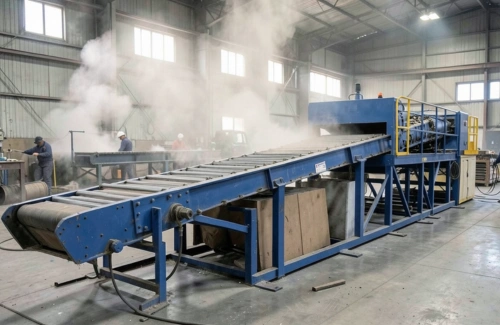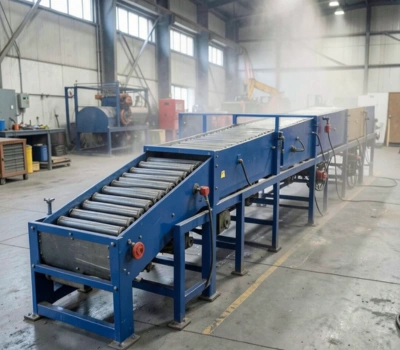
Our systems atomize water into fine droplets that collide with airborne dust particles. These bind together and fall back onto the material stream — reducing airborne particulate without wetting the material.
Installed at transfer points, loading chutes & discharge ends
Optional automation via conveyor motion sensors or PLC
Water-efficient: as low as 5–10 L/hr per nozzle (dry fog)
Low maintenance with clog-resistant nozzles

Up to 90% reduction in airborne dust – Captures dust at the source using fine mist or fog.
Prevents material buildup & blockages – Keeps chutes, belts, and transfer points clear.
Extends equipment lifespan – Minimizes abrasive wear caused by dust accumulation.
Enhances visibility and worker safety – Improves onsite air quality and working conditions.
Reduces maintenance & downtime – Cleaner systems need fewer repairs and interventions.
Minimizes reliance on dust extraction – Effective suppression reduces need for costly extraction units.
Complies with Qatar’s MOECC regulations – Helps meet environmental control and emission standards.
Ultra-Fine Fogging (1–100 microns) – Captures fine airborne particles without wetting materials
Modular Nozzle Arrays – Easy installation at transfer points, chutes, and junctions
Corrosion-Resistant Components – Built for Qatar’s harsh industrial climates
Low Water Consumption – Optimized nozzles reduce waste while maintaining effectiveness
24/7 Operation-Ready – Designed for continuous material flow and rugged duty cycles
Compatible with All Conveyor Types – From M-sand to coal, clinker to fertilizer
Easy Integration – Works with existing SCADA, sensors, or manual controls
Manual Control Panels – Simple on/off switches for operator-led control
Sensor-Triggered Activation – Automatically starts sprays when conveyor movement is detected
Timer-Based Operation – Scheduled misting cycles for continuous dust control even in non-automated plants
Enable sustainable, off-grid system operation—ideal for remote conveyor locations.
Remote monitoring and control through mobile apps or SCADA systems for smarter dust management.
Integrated additive systems to neutralize odors or bind fine particles where required.
Ensure accurate system performance with real-time monitoring and diagnostics.
SFLO conveyor dust suppression systems are engineered to serve a wide range of dust-generating industrial operations across Qatar. We ensure cleaner, safer, and compliant material handling at every stage:
Effective misting at transfer chutes, hoppers, and junction towers reduces coal dust at high-velocity points.
Suppresses fine dust during conveyor transfers to and from silos, elevators, and packing zones.
Fog systems installed at crushers and long belt runs prevent fugitive dust during heavy-duty aggregate movement.
Controls fine metallic and sinter dust during material discharge and inter-process belt transfers.
Applied at vibrating screens, feeders, and output belts to manage high-dust loads and maintain visibility.
Mitigates dust from conveyor systems used in ship loading/unloading of coal, clinker, bauxite, and aggregates.
Safely suppresses dust from fine powders and granules without chemical interference.

Fast response across Doha, Mesaieed, Al Khor, and Ras Laffan with local engineering and service teams.
Custom-designed systems for any material type, conveyor configuration, or site layout.
Built tough with corrosion-resistant, dustproof components suited for harsh climates.
Easily integrates with plant control and monitoring systems for seamless operation.
Low water consumption, no chemicals, and optimized spray cycles for sustainable dust control.
Yes. Our systems can be activated manually, by sensor triggers (based on belt motion), or via timers. SCADA/IoT integration is also available.
Dry fog systems use very little—around 5–10 liters/hour per nozzle. High-pressure systems may use more but are still water-efficient.
Absolutely. Our modular design allows for easy integration with both new and existing conveyor systems.
Yes. It supports compliance with MOECC (Ministry of Environment and Climate Change) guidelines for dust control and worker safety.